

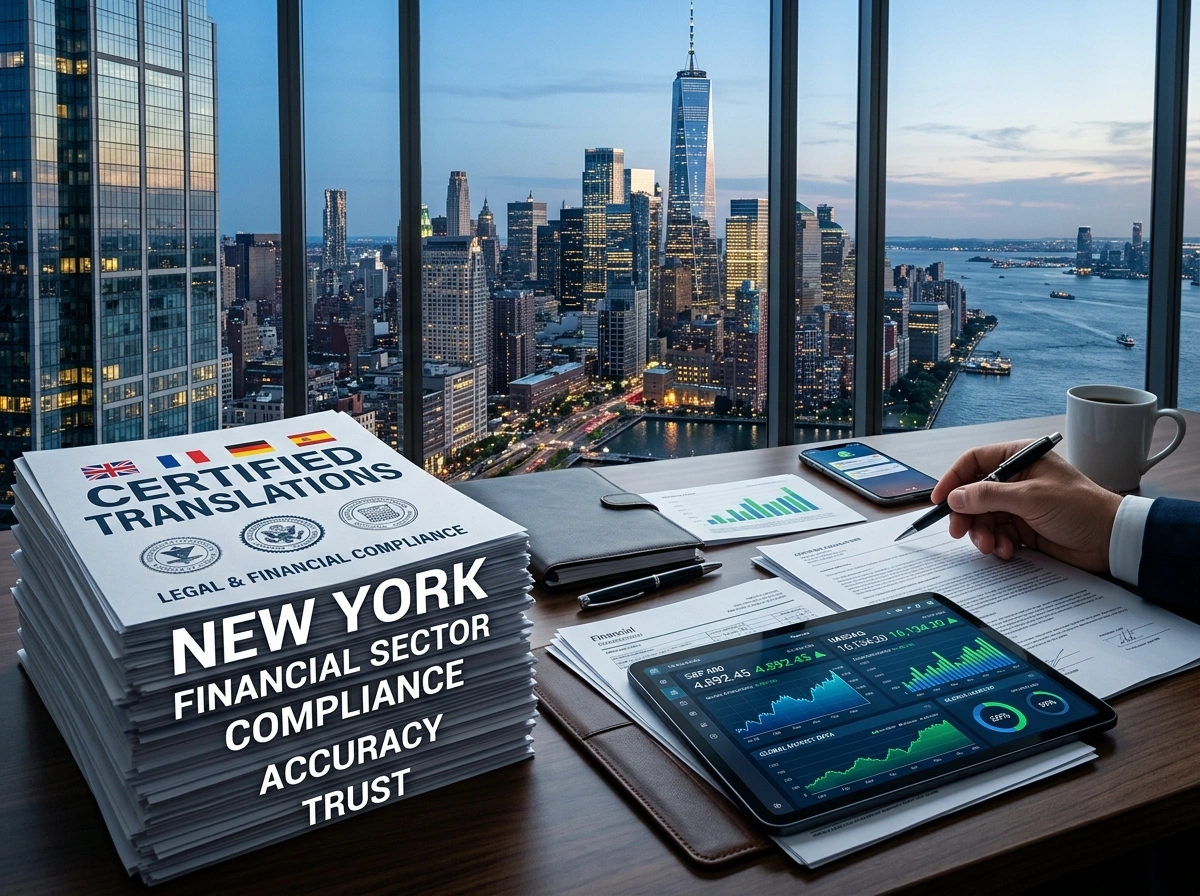
Wall Street remains the undisputed global capital of finance. Hundreds of international banks, investment firms, and emerging financial technology startups operate across Manhattan and the surrounding boroughs. Because of this massive international footprint, enormous amounts of multilingual data and documents flow through the city every single day. New York acts as the primary gateway for foreign capital entering the United States, making seamless communication across different languages a daily operational requirement.
As global markets become deeply intertwined, institutions face immense pressure to communicate across language barriers without making critical errors. A simple misunderstanding in a foreign market analysis or an improperly translated legal contract can derail a multi-million-dollar deal. Financial firms must handle foreign-language documents with the exact same rigor and precision they apply to their native-language financial modeling.
This guide explains why accurate, legally compliant language solutions are a core requirement for doing business in this high-stakes environment. You will learn how precise translations impact regulatory compliance, the specific challenges of translating complex economic data, and why standard translation methods often fall short in the eyes of federal regulators.
The Critical Role of Accuracy in Financial Translations
Financial translation requires highly specialized knowledge of economic terminology, international accounting standards, and local market dynamics. General translators often struggle with financial texts because everyday words frequently take on entirely different meanings in an economic context. For example, the word “turnover” means one thing in a retail environment but has a very specific accounting definition in British finance.
A single misplaced comma or a poorly translated financial term can change the entire meaning of an earnings report, a cross-border merger agreement, or a corporate prospectus. If an auditor misinterprets a foreign asset declaration due to a poor translation, the resulting financial assessment will be completely compromised. This lack of clarity can lead to severe miscalculations in risk assessment and asset valuation.
To prevent these costly errors, financial institutions rely on subject-matter experts. These specialized translators often have backgrounds in accounting, corporate law, or investment banking. They understand how to adapt complex concepts from one language to another while preserving the original financial intent. This deep industry knowledge ensures that investors, board members, and regulatory bodies receive an accurate picture of a company’s financial health.
Regulatory Requirements and Compliance
New York’s financial sector operates under the watchful eyes of the Securities and Exchange Commission (SEC), the Financial Industry Regulatory Authority (FINRA), and various international regulatory bodies. These agencies demand total transparency from the institutions they oversee. When dealing with foreign entities, this transparency requires translating legal and financial documents into English for official review.
Anti-money laundering regulations and Know Your Customer guidelines specifically demand precise documentation. Institutions must accurately verify the identities, business licenses, and financial histories of overseas clients before opening accounts or executing trades. If a bank receives a corporate registry or a background check in Spanish, Russian, or Mandarin, they must translate it accurately to assess the client’s risk profile.
Non-compliance with these strict regulations can result in massive fines, legal action, or the loss of operating licenses. Regulators do not accept “lost in translation” as a valid excuse for reporting failures. By utilizing professional translation services, financial firms ensure their reporting meets the exact standards required by state and federal authorities, protecting the institution from devastating legal liabilities.
Why Certification is Essential for Financial Institutions
Standard translation is simply not enough for official court filings, federal audits, or corporate immigration applications. Government agencies and legal entities require proof that a translation is entirely accurate and unaltered. This is where the certification process becomes absolutely vital for financial institutions operating in the city.
A certified translation includes a signed Certificate of Accuracy. This document features a formal statement from the translator or the translation agency, affirming that the translated text is a complete and exact rendering of the original source document. U.S. Citizenship and Immigration Services (USCIS), federal courts, and major universities all mandate this specific format for foreign-language submissions.
For businesses operating in the city, utilizing professional certified translation services new york provides the legal guarantee that documents meet the strict standards of U.S. federal courts and government agencies. This certification acts as a protective shield against legal disputes regarding document authenticity. When a bank submits a certified translation of a foreign tax record during a federal audit, the certification provides the auditor with the necessary confidence to accept the document as factual evidence.
Impact of Globalization on New York’s Financial Sector
New York City is a remarkably diverse metropolitan area. Over 200 languages are spoken across its five boroughs, with Spanish, Chinese, Russian, and French serving as major languages of commerce. This incredible linguistic diversity reflects the city’s role as a global economic hub. European banks, Asian investment funds, and Latin American corporations all establish major footprints in the city to access U.S. capital markets.
This constant cross-border dealmaking requires translating an enormous volume of documents on a daily basis. A single international merger might require the translation of shareholder agreements, tax records, corporate bylaws, and employee contracts. The ability to process these documents quickly and accurately directly impacts a firm’s ability to close deals and secure investments.
Globalization also means that financial crises or market shifts in one region immediately impact institutions in New York. Analysts need real-time translations of foreign news reports, government press releases, and central bank statements to make informed trading decisions. As a result, the demand for fast, reliable language services continues to grow alongside the expansion of global trade.
Challenges in Translating Complex Financial Documents
Translating financial documents presents unique hurdles that go far beyond basic language fluency. Different countries use entirely different accounting frameworks. Translators must navigate the complex transition between Generally Accepted Accounting Principles (GAAP) used in the United States and the International Financial Reporting Standards (IFRS) used across Europe and many other regions. Finding the correct equivalent term requires a deep understanding of both systems.
Another major challenge is maintaining strict data security. Financial documents contain highly sensitive, market-moving information. Leaks or data breaches during the translation process can lead to insider trading, corporate sabotage, or severe regulatory penalties. Translation agencies handling financial documents must implement enterprise-grade cybersecurity measures, including encrypted file transfers and strict non-disclosure agreements for all staff.
Speed is also a critical factor in the financial sector. Markets move incredibly fast, and businesses often need urgent turnarounds for their regulatory filings or press releases. An earnings report might be finalized just hours before it needs to be published in multiple languages simultaneously. Translators must deliver flawless work under immense time pressure, a feat that requires highly coordinated project management.
Future Trends in Financial Translation Services
Technology continues to reshape how translation agencies operate within the financial sector. Artificial intelligence and machine translation tools can now process vast amounts of data in seconds. Financial institutions use these tools to quickly scan foreign market reports or assess the general sentiment of international news articles.
However, human experts remain absolutely vital for reviewing and certifying the final output. The industry is rapidly adopting a model known as Machine Translation Post-Editing (MTPE). In this workflow, an AI generates the initial translation, and a human financial expert rigorously edits the text to ensure perfect accuracy and correct terminology. This hybrid approach allows agencies to handle massive document volumes while maintaining the strict quality standards required for certification.
We will also see tighter integration between enterprise financial software platforms and secure translation portals. Companies will soon be able to order certified translations directly from their internal document management systems, streamlining the entire procurement process. Additionally, the demand for niche languages will likely increase as investment capital flows heavily into emerging markets across Africa and Southeast Asia.
Securing Your Global Financial Operations
The financial landscape in New York relies heavily on clear, legally sound communication across borders. As international investments grow and regulatory oversight tightens, the need for precise language services will only become more critical. Cutting corners on document translation can lead to costly compliance failures, broken business deals, and severe financial penalties.
Firms must partner with reliable translation providers who deeply understand the rigorous demands of the financial sector. By prioritizing accuracy, confidentiality, and proper legal certification, organizations can safely navigate international markets. Ensure your institution remains compliant, competitive, and ready for global growth by investing in professional, certified language services today.
